
You ask AI to organize a report.
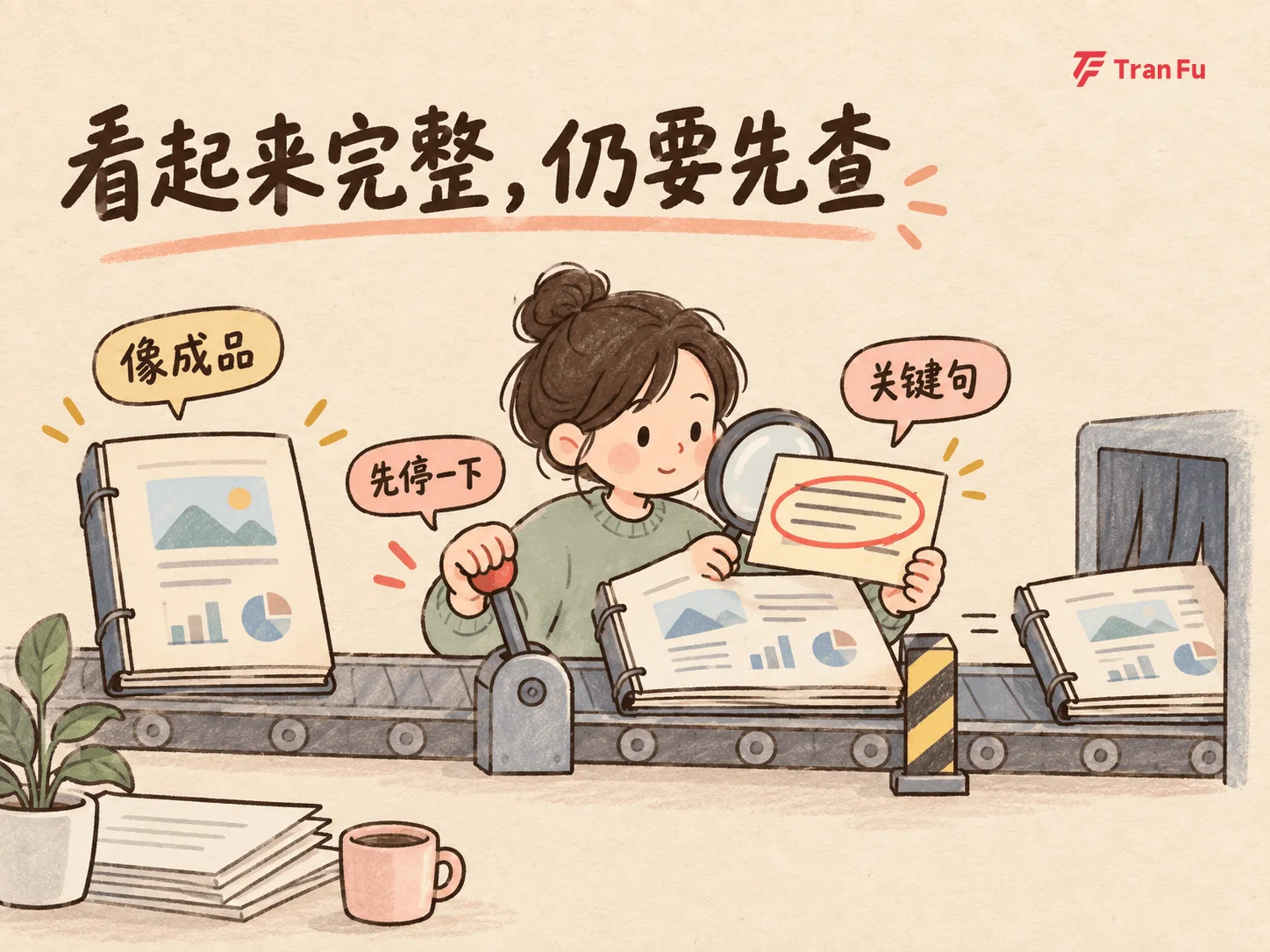
It gives you conclusions, adds references, and includes papers, tables, or code links. The layout looks finished, and the tone sounds confident.
At that moment, the easiest move is to skim the text and send it to a leader, client, or reader.
That is often where the problem starts.
Complete-looking content only means it resembles a finished draft. It has not answered: who made this claim, what did we actually verify ourselves, and what happens if someone acts on this sentence?
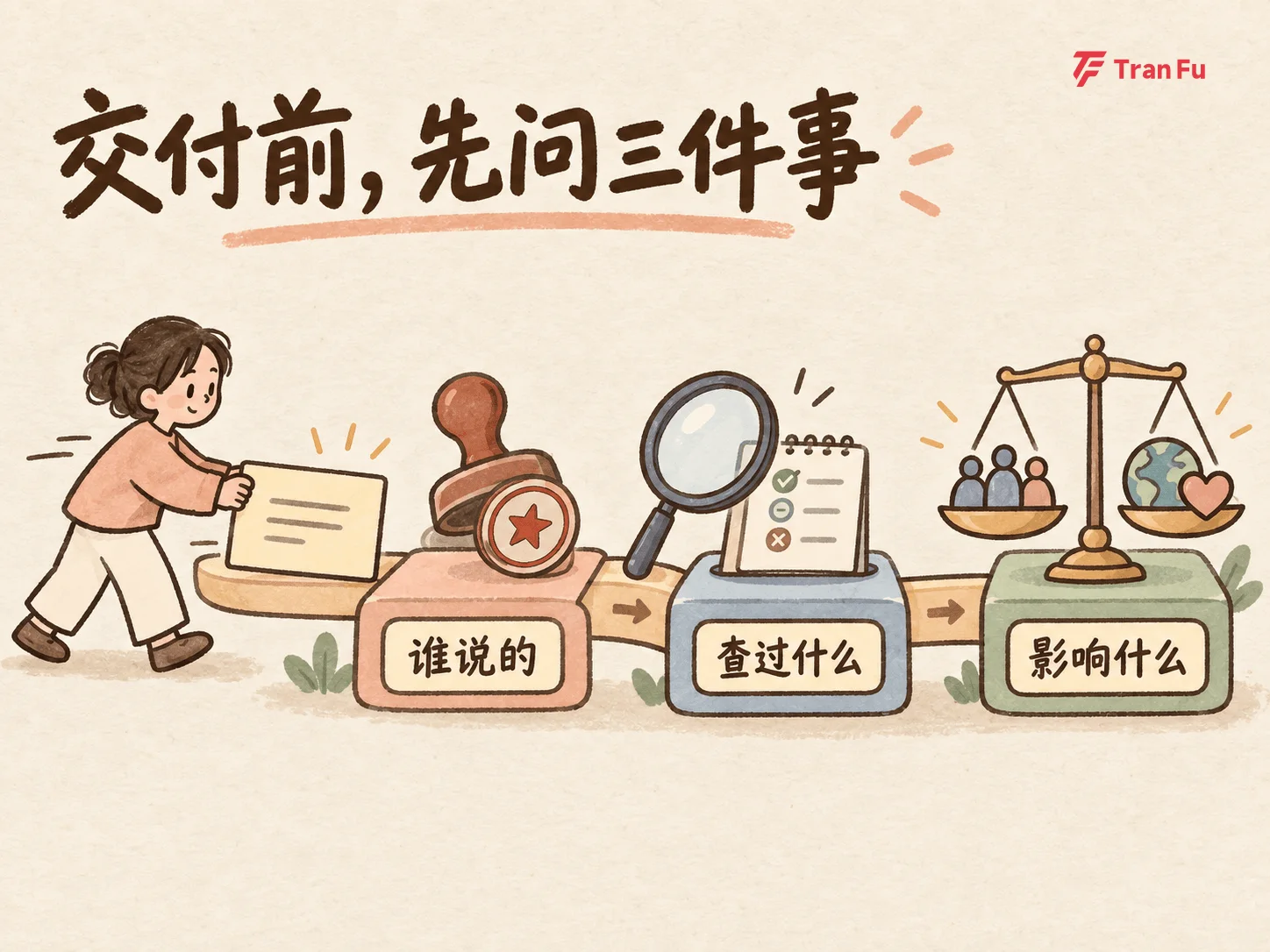
Before delivery, do not rush into reviewing the whole document line by line. Circle the most important sentence, the one most likely to affect a decision, and ask yourself three questions:
-
Who said this?
-
What did we actually check?
-
Who will see this sentence, and what could it affect?
If all three answers are clear, the sentence can continue in its current form. If they are not clear, it does not mean the sentence is definitely wrong; it only means we cannot state it with that much confidence yet.
Having the Materials Is Not the Same as Confirming Them
A recent news story makes this problem very clear.
On September 8, 2026, OpenAI published papers and Lean formalization materials related to Navier-Stokes, describing the work as a solution generated by its internal system. The public repository also provided Lean files, toolchain versions, build commands, and check entry points.
But as of September 10, 2026, the corresponding Clay Mathematics Institute page still showed Unsolved. OpenAI also said it did not intend to claim the related Millennium Prize. That only represents the official position at the time of publication; it cannot be used in reverse to prove whether the result is valid or invalid.
Attribution and data sources should not be collapsed into one sentence either. OpenAI acknowledged Levent Alpoge and Tristan Buckmaster's priority on forced Euler results and distinguished the scope of its own stated result.
Regarding data sources, OpenAI denied that its researchers and agents had seen the related work before it became public, and denied that they had access to specific user data. At the same time, OpenAI said it could not completely rule out that de-identified product usage data had helped improve its models. MIT Technology Review reported the accusations and denials, while leaving the question of whether the model used the related work as unresolved.
The current materials support “OpenAI published and stated.” They do not support compressing the story into “the problem has been formally solved,” nor into “plagiarism has been proven” or “the dispute has been clarified.”
For most readers, the useful point in this case is not the mathematics itself. It is the reminder that having the materials is not the same as having confirmed them.
Question One: Who Said This?
AI is very good at turning multiple sources into one smooth sentence. Once the subject disappears, another person's judgment can easily become our conclusion.
The following statements may look similar, but they carry different responsibilities:
-
“An institution published...” describes an act of publication.
-
“An institution stated...” reports what that institution said.
-
“A media outlet reported...” shows that the information came from interviews or reporting.
-
“We confirmed...” means we actually performed checks that match the sentence.
More links do not automatically change who made the claim. A release page, technical note, and code repository from the same institution can complement one another, but they cannot turn “they stated” into “we confirmed.”
Put the subject back into the key sentence. If you only have the publisher's materials, write who published it or who stated it. If the information comes from media, keep the outlet name and the scope of the reporting. If you cannot find the original source, remove the claim for now or keep looking.
Question Two: What Did We Actually Check?
“I checked it” is too broad.
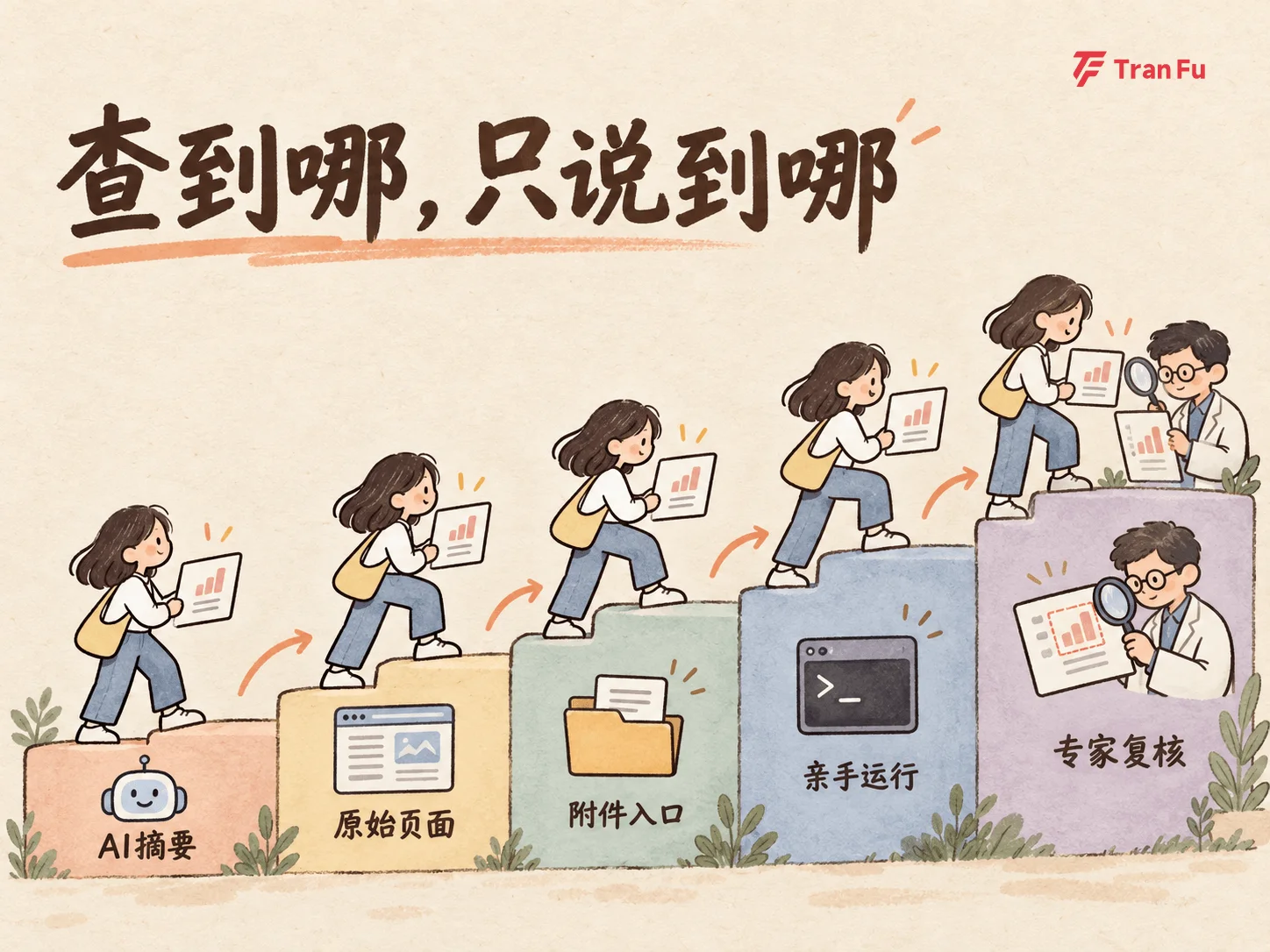
Reading an AI summary, opening the original page, finding attachments, running code yourself, and asking a domain expert to review it all support different strengths of wording.
Describe your own actions specifically:
-
Only read an AI summary: you still do not know whether it omitted conditions or misread the source.
-
Opened the original page: you can confirm what the page said at the time you accessed it.
-
Found the attachment or code repository: you can confirm the materials and entry points exist.
-
Ran it yourself: you also need to record the environment, versions, commands, and actual results.
-
Asked someone knowledgeable to review it: specify which part they reviewed; do not let a credential endorse the entire document.
Look again at OpenAI's public repository. We can confirm that the repository and check entry points exist, but this verification did not run those checks and did not judge whether the proof is correct. Therefore, we cannot write “we have run it successfully” or “the proof has been confirmed.”
The Clay page showing Unsolved only records the page state as of September 10, 2026; it does not replace professional evaluation of the paper.
At delivery time, write one line for “what we checked” and one line for “what we did not check.” The next person who takes over can see where the work stands and where to continue.
Question Three: Who Will See This, and What Could It Affect?
The same sentence can have completely different consequences in different places.
It may only be a note for yourself to investigate later, or it may enter a team report, client commitment, or public article. Different uses create different consequences.
“Internal use” does not automatically mean low risk. If an unsourced conclusion enters an important decision, it can still have real impact.
Public content also does not have to be impossible just because there is no final conclusion. Clearly explaining who published what, what can currently be confirmed, and what remains unconfirmed can still be valuable.
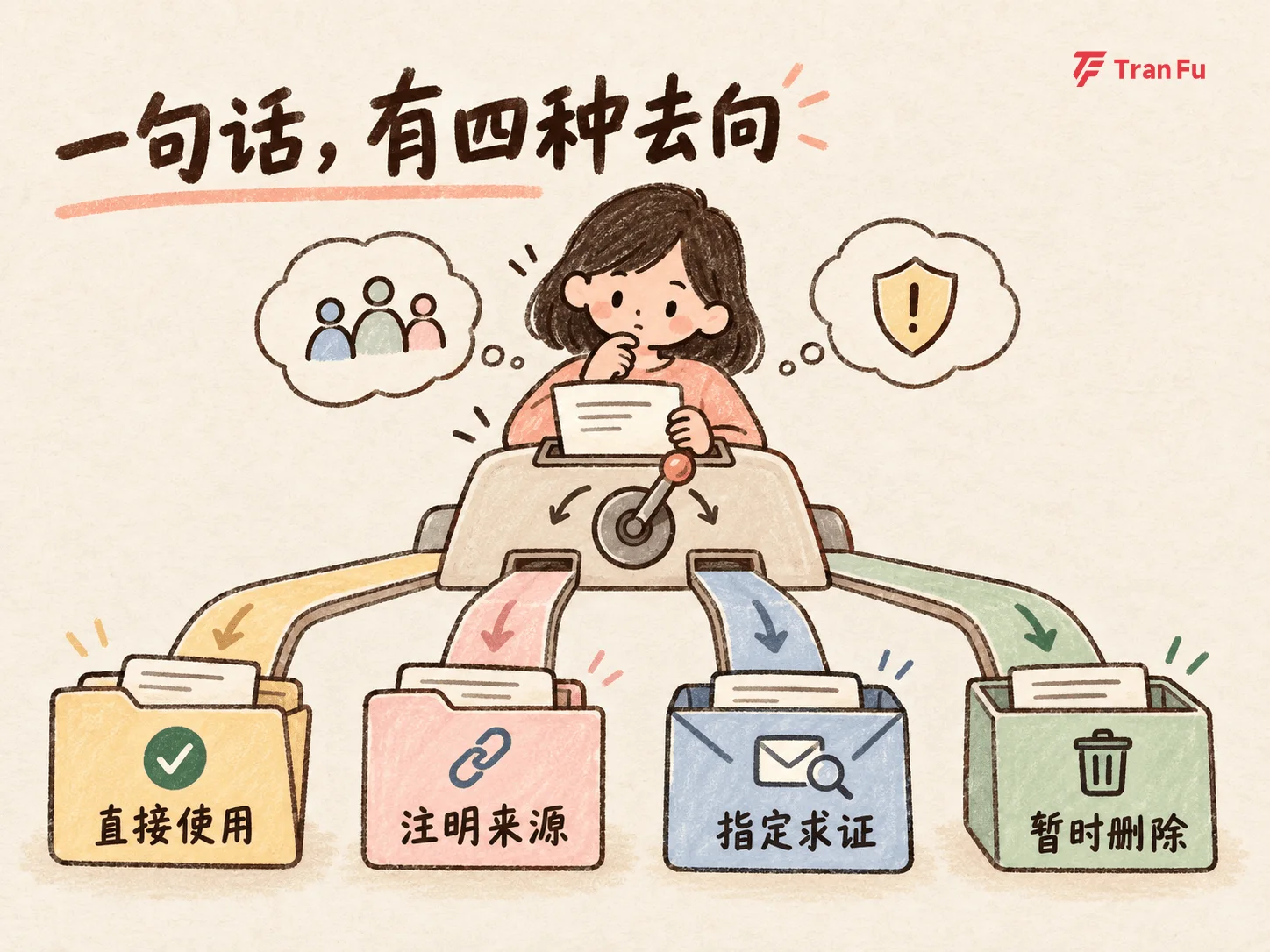
Depending on the audience and consequences, there are four possible treatments:
-
Use it directly: we really checked it, and the wording does not go beyond the known facts.
-
Use it with attribution: the information is worth keeping, but it remains the claim of an institution, author, or media outlet.
-
Send it only to specific people for verification: the content may be valuable, but professional judgment exceeds our current ability, or sources still conflict.
-
Remove it for now: the source cannot be found, key conditions are missing, or the consequence of using the sentence is more than we can responsibly bear.
These four treatments decide how far one important sentence can go right now. They are not labels that make the entire report “trustworthy” or “untrustworthy.”
Copy This Four-Line Check Card
You do not need a complex process first. Copy the four lines below and check only the most important sentence this time:
Sentence to use: What exactly did the AI write?
Original source: Who said it, when, and where?
Actual verification: What did we personally look at or do, and what have we not done?
Audience and treatment: What could it affect; should we use it directly, use it with attribution, send it for targeted verification, or remove it for now?
Applied to the earlier case, “OpenAI has solved the Navier-Stokes Millennium Prize Problem” cannot be used directly. The current materials support this wording:
OpenAI published related papers and Lean formalization materials on September 8, 2026, and described them as a system-generated solution; as of September 10, 2026, the corresponding Clay Mathematics Institute page still showed Unsolved.
This sentence preserves the publisher, time, and current status. It does not substitute for the mathematical community's judgment, and it does not imply that this verification ran the public repository.
When Not to Keep Going with This Card
This card helps reveal gaps; it does not replace professional judgment.
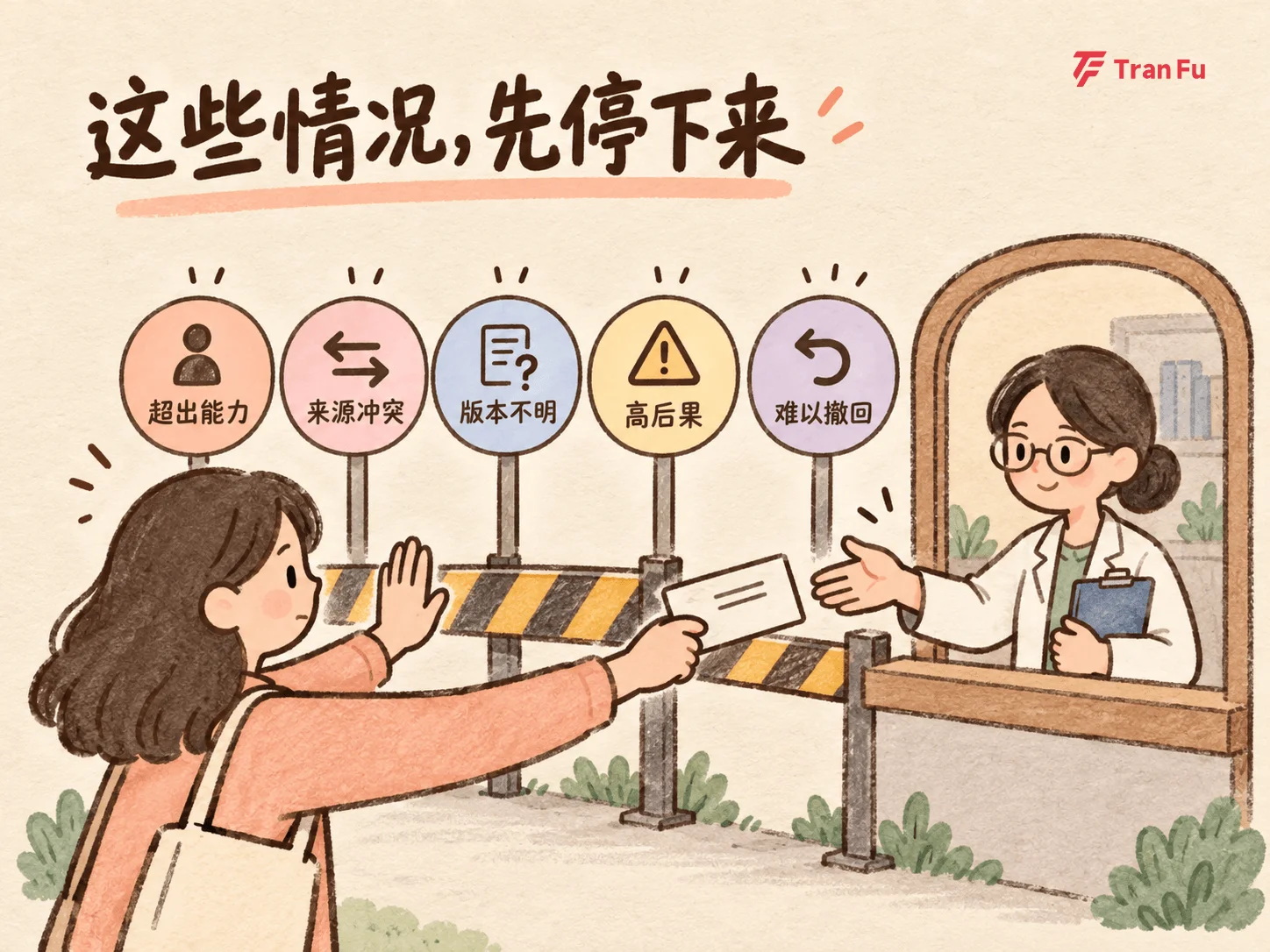
When any of the following situations appears, stop and hand it to the responsible person or an appropriate specialist:
-
The professional correctness of the conclusion exceeds the team's ability;
-
Different sources conflict and the current materials cannot explain why;
-
The original materials cannot be opened, or the version cannot be determined;
-
The content will enter high-consequence contexts such as medical, legal, financial, safety, or scientific claims;
-
Once published or executed, it would be hard to reverse.
The next time AI gives you a report that looks complete, do not rush to polish it. Circle the most important sentence and write down who said it, what we checked, and who will see it.
The answer may not appear immediately, but you will know how to treat that sentence: use it directly, add attribution, send it to a specific person for verification, or remove it for now.