A message arrives in the work group:
Can we move tomorrow morning’s review to the afternoon? I still haven’t received the latest materials. Also, please add Xiao Zhou.
If we give the whole message to a chat AI and ask it to summarize, classify, check the calendar, draft a reply, and send a notification, we may get a polished response that misses the missing materials—or sends the new time to everyone before anyone confirms it.
The problem is not the writing. Several different jobs are mixed into one message.
What makes Jev worth watching is not that it chats better than a general model, but that it isolates one small judgment.
Jev in plain language
A general model is like an all-purpose assistant: it can chat, write, and plan, but it organizes a complete response every time. Jev is more like a sorter that only answers a multiple-choice question. You provide a message and a few predefined options; it checks one or more answers such as “reschedule,” “materials missing,” “add a person,” or “information incomplete.”
It does not write a long article, check your calendar, or press Send for you. It can also make a true-or-false judgment or assign a simple score, but its core job remains choosing from a bounded set of answers.
When connected to a chat interface, the surrounding product can show results such as “handle today,” “waiting for materials,” or “route to a person,” so someone can choose the next step. The product interface is what chats with people and displays the buttons; Jev only decides which option best fits the message. At most, it completes one step in the thinking process—it does not make value judgments, trade-offs, or final decisions for you.
Jev is a recently released TypeSafe AI tool that is still in early use. The point of discussing it now is not to replace your existing tools immediately, but to understand why this division of labor—outsourcing one small judgment—exists.

Why make this a separate job?
Much of the work in automation is not writing a long email. It is repeatedly making the same small judgment across a large number of messages: which category an email belongs to, whether materials are missing, or whether a person should review it.
If every small judgment calls a full general-purpose model, waiting time and usage cost accumulate. Put simply, if a cheaper and faster method can handle the small judgment, the model responsible for writing a complete answer does not need to rebuild the reasoning from scratch every time. The design goal of tools like Jev is to handle fixed-answer decisions lightly; the general model can keep handling complex understanding, planning, and drafting, while code or a calendar handles precise calculations. A person still confirms actions that affect others.
“Faster and cheaper” is a design direction, not a guarantee for every task. Before connecting it to a real workflow, test it with your own messages and the cost of mistakes.
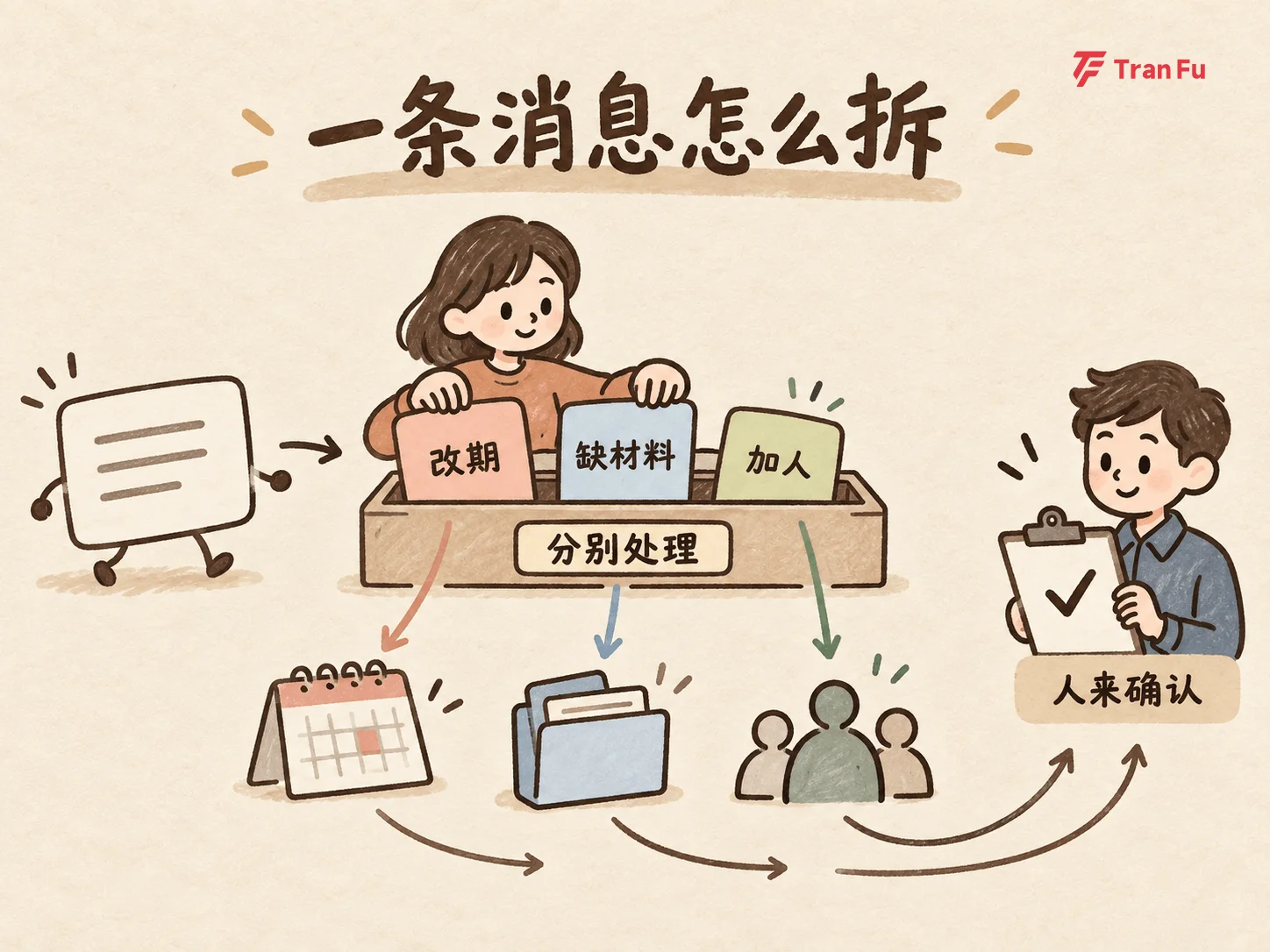
How should one message be divided?
Take the meeting-rescheduling message above. Its workflow can be split into four kinds of work:
- Jev: identify the requests and route them to predefined categories.
- A general model: draft a response after the categories are known.
- Rules, code, or a calendar: calculate times, durations, conflicts, and recipients precisely.
- A person: confirm the final action before it changes someone else’s schedule or sends a notification.
So the sensible route is: Jev triages first, the general model drafts next, the rule system calculates, and a person confirms last.
This is easier to inspect than asking one chat box to own the entire process: every step has a clear job and a clear point where it must stop.

Where can ordinary users apply it?
-
Work email and group messages: first sort them into “handle today,” “waiting for materials,” “for information,” or “needs human review,” then let a general model draft a reply for each category. Jev routes; it does not send.
-
Expense or purchasing documents: label them “materials complete,” “invoice missing,” “amount mismatch,” or “needs review,” and surface the cases that need a person. Formula or finance systems still verify amounts; nothing should be approved automatically just because a label was assigned.
-
Meeting or event registration: sort messages into “attending,” “cannot attend,” “requesting another time,” or “information incomplete,” then send them to the right task list. Calendar rules and the responsible person still control scheduling and the final notice.
The common pattern is a relatively clear answer space combined with a high volume of messages. Jev saves repetitive sorting; it does not take responsibility for the decision.
Three easy traps
A valid label does not mean the judgment is correct.
A message may say both “reschedule” and “materials missing.” If the system checks only “reschedule,” the format is valid but the second request disappears. Labels should allow multiple selections and keep options such as “other” and “information incomplete.”
Understanding a time does not mean scheduling it correctly.
A model may recognize “afternoon” without handling time zones, meeting length, or calendar conflicts. Let a model extract information; let a calendar, formula, or program perform precise calculations.
Confidence is not permission to execute.
A confidence score is, at most, a routing signal. The higher the cost of an error, the higher the threshold for human review. Expense approval, an announcement to everyone, and a shared-calendar change should never be released on the basis of one score alone.

Run one small experiment today
Choose a process that gets reworked every week and test a small batch of real historical messages in four steps:
- Have a person label each message, allowing “other” and “uncertain.”
- Let Jev check labels only; do not connect it to sending, approval, or calendar changes.
- Compare its results with the human labels and record wrong classifications, missed labels, and insufficient information.
- Only connect a downstream tool after the results are stable.
Jev is suited to repetitive, bounded judgments. Its value is not replacing general models, but taking away the small chores they do not need to handle so that each tool performs the narrow, inspectable part it is good at.